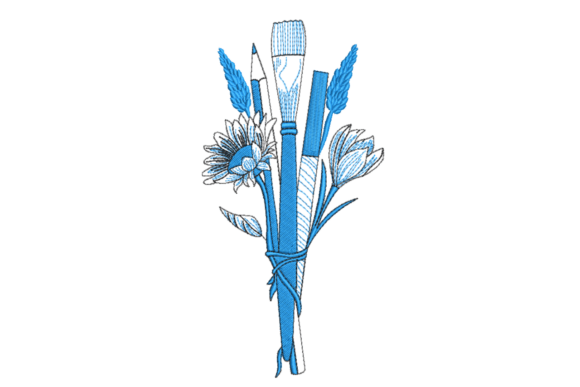
A Design Review: Blue Art Tools Bouquet for Business
When a small business asks me to evaluate an embroidery design for their branded merchandise, my perspective shifts from pure aesthetics to practical viability. The Blue Art Tools Bouquet immediately presents a unique challenge: it’s inherently decorative, but can it function as a robust brand asset? Let’s walk through a real-world review, imagining a client—perhaps a creative studio, a neighborhood bakery with an artsy vibe, or a boutique stationery shop—wanting to use this design on their aprons, tote bags, or as a custom patch.
First Impression: Balancing Playful Charm with Professional Potential
The title suggests a collection, a “bouquet” of tools, rendered in blue. This creates an immediate, friendly, and slightly playful impression. It feels less like a stern corporate logo and more like a handmade or craft business signature. For businesses in the creative, culinary, or educational spaces (the School category hint is useful), this personality is a strong starting point. It conveys a sense of craft and attention to detail, which can enhance customer trust and perceived product value. However, the key question for a professional embroidery designer is: does this charm translate into clean stitches and clear recognition at various sizes?
Real-World Application: Where This Design Excels
For small business merch, the applications are plentiful, provided the design’s complexity is managed.
- Embroidered Patches: This is a prime candidate. A Blue Art Tools Bouquet patch could be stunning on a denim jacket, a canvas tote, or as a reward for loyal customers. It would serve as a perfect, detachable brand accent for event merch or limited-edition products.
- Apron & Work Shirt Embroidery: For a creative studio or bakery, this design as a chest logo on an apron or sleeve detail on a uniform adds a distinctive, non-generic touch that reinforces a specialized brand identity.
- Tote Bag & Product Packaging Accents: Embroidered onto a cotton tote, it becomes a functional, reusable piece of brand advertising. As a smaller accent on product packaging tags or labels, it elevates a handmade product presentation.
- Cap Embroidery: On the curved front of a cap, a simplified or well-adapted version of the bouquet could create a unique, recognizable look for staff or branded merchandise.
The design’s decorative nature means it inherently adds visual consistency across different products, making a café’s apron, tote, and staff cap feel like part of a cohesive brand family.
Caution Areas: Navigating Complexity for Commercial Embroidery
This is where my designer instincts kick in. A “bouquet” implies multiple elements, likely with details and outlines. For successful commercial embroidery, careful consideration is needed.
- Small Patch Sizes & Cap Fronts: If the design is too detailed, shrinking it for a small patch or a cap front risks muddling the individual “tools.” Fine details may become lost or create problematic stitch density.
- Detailed Outlines & Lettering: If the design includes tiny text or intricate outlines, these can be challenging on textured fabrics like twill or denim, requiring precise hoop size and stabilizer selection.
- Dark Uniforms & Fabric Texture: A single blue palette on a dark fabric needs excellent thread color contrast to remain visible. Testing on the actual fabric texture intended for use is critical.
- Items for Frequent Washing: High-density areas in a complex design must be stitch-stable to withstand repeated laundering on work shirts or aprons without puckering or thread breaks.
The Brand Impact: From Decoration to Trust Signal
Using Blue Art Tools Bouquet effectively transforms it from mere decoration into a brand signal. For a small business, this embroidery on a staff uniform communicates professionalism and a unified team. On merchandise, it increases the item’s intrinsic value, encouraging buyer engagement as customers are more likely to use and display a beautifully branded product. It fosters recognition—a customer seeing the same design on a shop’s Instagram, on their purchased tote, and on the staff’s cap builds a strong, memorable visual connection. For Etsy sellers or craft businesses, it provides a premium, handmade finishing touch that distinguishes their products in a crowded marketplace.
Practical Designer Notes Before You Hoop the File
Before running this digital embroidery file for a client’s project, here is my standard checklist.
- Test in Black and White First: Create a simple mockup. This strips away color and helps you see if the composition and elements hold their shape at your intended size.
- Check Small Patch Size Performance: Hoop a small version (e.g., 2 inches) on scrap fabric. Are the key elements still identifiable? Does the stitch count look manageable?
- Review Thread Color Contrast: Plan your blue thread(s) against your target fabric colors. Consider a slightly lighter blue for dark backgrounds if the design file doesn’t specify.
- Inspect Spacing & Density: Look closely at the embroidery file preview. Are elements too close, risking stitch overlap? High density areas need proper stabilizer.
- Test on Real Fabric: Never skip this. Run a sample on the exact apron canvas, cap twill, or tote bag cotton you’ll use for the final product.
- Create a Printable Mockup for Client Approval: Show the client how it will look on a product. This avoids misunderstandings and confirms the design meets their brand identity goals.
- Compare Beside Other Assets: Place the embroidered sample beside your client’s other branding—their logo, typography. Does it complement or clash?
- Confirm Commercial Licensing: Crucially, verify the license terms of the Blue Art Tools Bouquet file itself. Ensure your client’s intended use—selling embroidered merchandise—is permitted before any production begins.
In conclusion, the Blue Art Tools Bouquet holds significant potential for small businesses seeking a distinctive, craft-oriented brand mark. Its success hinges not on its beauty alone, but on a meticulous, professional approach to adaptation and execution. By treating it as a serious design asset and following rigorous pre-production tests, you can transform this decorative embroidery design into a powerful, profitable element of your client’s brand story.